 edifyingworld
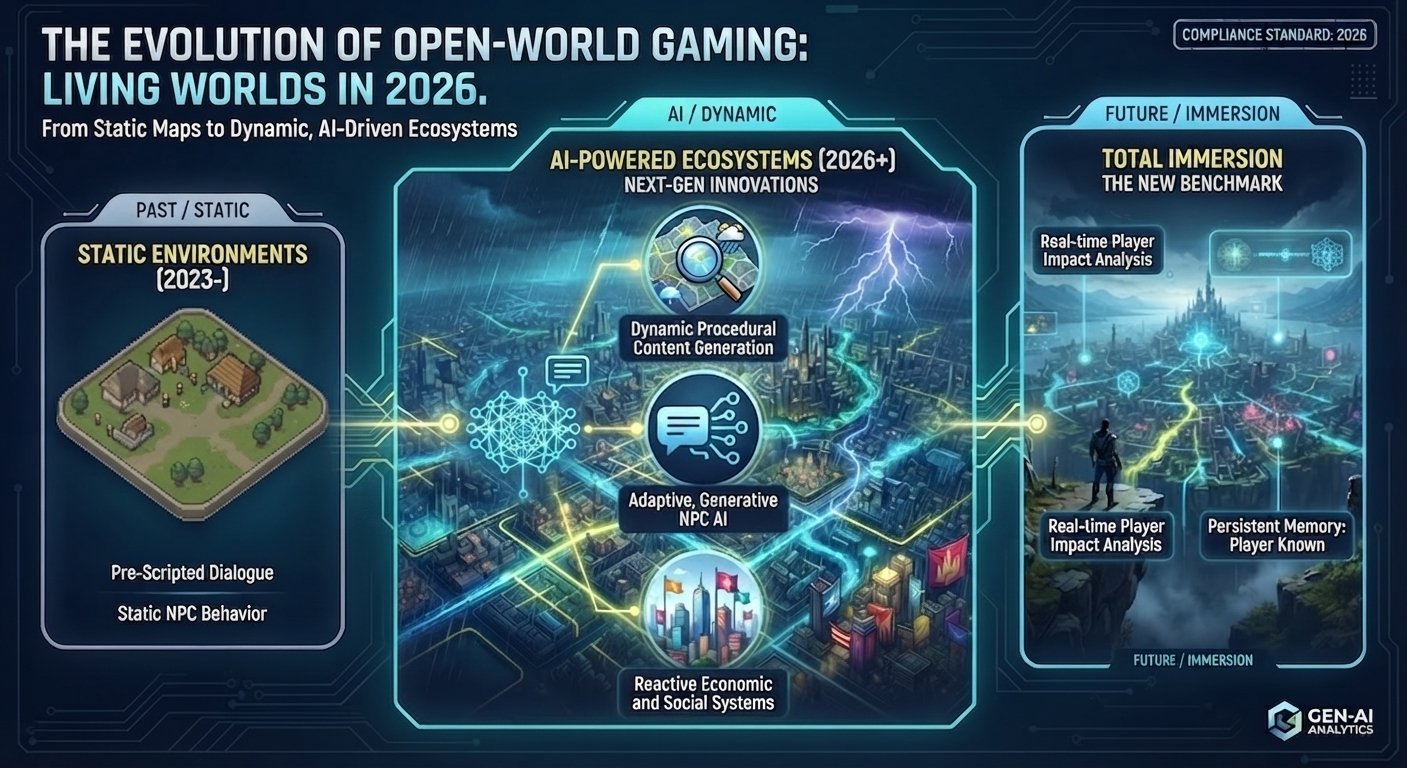
For years, the gold standard of open-world gaming was simply map size. Players were dropped into sprawling digital landscapes, but behind the beautiful graphics, the worlds were often static. In 2026, the gaming industry is undergoing a monumental shift. The modern benchmark for a successful open-world title is no longer just scale; it is deep, reactive immersion driven by next-generation artificial intelligence and dynamic ecosystem design.
As we look at the landscape of modern interactive entertainment, a few core technological pillars are completely reshaping how players experience virtual exploration.
The End of Scripted Interactions: The Rise of AI NPCs
Perhaps the most significant leap forward in modern open-world games is the evolution of non-player characters (NPCs). For decades, NPCs were strictly bound by predictable scripts—repeating the same lines of dialogue, patrolling identical routes, and offering very limited interaction.
Today, AI-powered NPCs are transforming game worlds into intelligent, living ecosystems.
- Adaptive Learning: Utilizing machine learning, NPCs can now learn from player behavior and adapt their actions. Enemies can react to specific player strategies, becoming more difficult and forcing players to adapt.
- Contextual Conversations: Thanks to Natural Language Processing (NLP) and generative AI, in-game characters can communicate realistically. Instead of exhausting a dialogue tree, players experience context-aware responses that dynamically generate based on past interactions.
- Persistent Memory: Next-generation AI allows NPCs to retain a memory of past interactions with the player, shaping long-term relationships and altering how communities or factions respond to the player over time.
These advancements mean that instead of feeling like automated theme park animatronics, NPCs act as genuine inhabitants of their digital worlds, making every player’s playthrough entirely unique.
Procedural Generation and Reactive Ecosystems
Artificial intelligence is not just rewriting character dialogue; it is actively reshaping the environments players explore. Procedural generation has evolved far past simply creating random terrain layouts.
In 2026, developers are utilizing AI to build complex, procedural ecosystems. Developers are able to set high-level rules, allowing AI to fill in the environmental details while balancing pacing, aesthetics, and gameplay difficulty. This technology allows for dynamic environments where NPCs adjust their daily routines based on in-game weather systems, shifting social hierarchies, or the player’s direct impact on the local economy.
Furthermore, storylines are adapting to these environments. AI-powered systems can seamlessly integrate side quests and character arcs into the main plot based on the unique choices a player makes, resulting in highly dynamic storytelling.
Blockbusters Defining the 2026 Landscape
Several highly anticipated titles are serving as the testing ground for these next-generation open-world mechanics:
- Grand Theft Auto VI: Expected to redefine the open-world genre, Rockstar’s latest installment utilizes the power of the PS5 and Xbox Series X/S to offer realistic physics, a highly dynamic world, and unprecedented world interaction.
- The Elder Scrolls VI: Cementing its place as a flagship open-world fantasy game, this massive RPG is pushing the boundaries of enhanced NPC AI and seamless environmental exploration.
- Cyberpunk 2077: Rewired: Following major updates and the Phantom Liberty expansion, CD Projekt Red has entirely overhauled the game’s AI, visual fidelity, and combat. This next-gen expansion stands as a celebrated benchmark for AAA innovation in 2026, demonstrating how heavily updated AI can breathe new life into an open world.
What This Means for the Future
The global AI in gaming market is experiencing explosive growth, projected to jump from $3.28 billion in 2024 to over $51 billion by 2033. With over half of game development companies now utilizing generative AI tools during the development process, the barrier to creating ultra-realistic worlds is lowering.
The evolution of open-world gaming proves that players are craving more than just visual fidelity. They want agency, unpredictability, and a world that pushes back. As AI and hardware continue to evolve in tandem, the line between virtual simulation and reality will only continue to blur.
 edifyingworld